What Amount of Manufacturing Overhead Costs Will Be Allocated to Jobã¢â‚¬â€¹ #316?
3.iii.1 Executing the Strategic Plan is Vital
A research thrust leader'southward work doesn't stop when the strategic plan is formulated; that's only the commencement, a prelude to the real effort. Constant follow-up is necessary (e.g., continually checking progress and resource expenditures against the programme). Also, as noted earlier, research thrust leaders accept to be willing to make adjustments to the program if necessaryâ€"especially with respect to budgets, resource allocations, and schedules.
“Many [businesses] have plans; few execute them well. In fact, intensive enquiry out of Harvard University indicates at least 85 percent of businesses do not execute their strategies effectively.†(Endnote 5.)
Below (sections 3.iii.2â€"three.3.6) are five businesslike approaches and one of import open outcome (section 3.3.7) for research thrust leaders charged with executing their strategic plans.
3.iii.2 Create and Sustain Buy-In
The goal here is to bear witness how a particular thrust fits into the overall strategic plan of the ERC and to convince thrust members of the importance of their roles in fulfilling the center’south larger vision and mission. To an extent, some buy-in may have occurred during training of the strategic plan. However, that buy-in may simply be transitory as the real work gets underway and the relevance of a particular project to a afar vision or mission dims in the minds of participants. Accordingly, the research thrust leader must constantly reinforce the relevance to the ERC’s goals and the consequent need for purchase-in every bit the projects continue.
Budget and resources resource allotment bug must be role of this best practise (e.g., what dollar and human resources will be allocated, and when?). Ideally, inquiry thrust leaders should participate in the middle-level budget and resources-allocation processes and have a articulate understanding of budgetary and resource-allocation responsibilities and regime, from the top of the ERC downward. However, the extent to which this is possible depends on the ERC and academy leadership. In any result, research thrust leaders must communicate conspicuously and oft with the ERC managing director, colleagues, and subordinates most budgets and resources allocations.
3.3.3 Identify and Optimize Critical Paths
Critical path chains should be optimized to reach the most efficient timelines, bearing in heed that some fundamental challenges may accept fourth dimension to resolve. Further, although interactions among squad members are to be encouraged, inapplicable interaction should be avoided so as to not complicate each critical path with unimportant connections. The projection goals can be accomplished without all players in the thrust being engaged with every aspect of the work.
In addition, the thrust leader should ensure in that location is no overlap in deliverables, such as 2 research efforts producing the same results. Coordination of deliverables between thrusts is as well important.
When necessary, research thrust leaders should support changes within the center to analyze the critical paths. Rationale for such changes could include achieving more realistic schedules, attaining better balance of budgets and resources along the paths, or implementing successful “workarounds.â€
To illustrate the terminal point, there might exist a situation in which a research thrust leader has to decide how to keep a research squad productive when waiting for a deliverable from some other thrust. Alternatively, a thrust leader may be faced with developing workarounds when an outside deliverable fails to materialize. A best practise would be to asking every project to have a Plan B if Plan A, which reflects input from some other thrust, has a schedule slip or doesn’t happen at all.
3.3.4 Establish Effective Communications within Thrust and with Rest of Middle
Continuous and constructive communications, both up and downwards the concatenation of control, are essential. With respect to levels of management higher up the thrust leader, communications must be clear, convincing, and concise. For levels parallel or below, in some cases research thrust leaders may need to rely on persuasion. Direct orders to other thrust leaders or independent researchers are probable to be seen as abrasive and fail.
Best practices to overcome communication difficulties include the post-obit:
- Define the goals and milestones as a team.
- Use video-conferencing and spider web-based advice systems.
- Plant regular schedules for meetings.
- Record minutes for key meetings and decisions.
- Develop a knowledge repository.
- E'er communicate with principal investigators and projection leaders.
- Don’t forget the telephone or face-to-face communicationsâ€"an east-mail service can be misunderstood.
- Push to nourish and interact at national meetings and professional person society meetings (where ERC budgets permit).
- Schedule retreats for academy students to show or nowadays their piece of work.
3.3.5 Monitor Progress and Deliverables
This topic addresses the following two aspects:
- Meetings and reports that illuminate various projects
- Metrics that measure progress and accomplishments.
Consideration here of meetings extends the preceding discussion of communications. Weekly or bi-weekly project meetings would exist desirable, if possible, as would monthly meetings with center executives. Still, a proper balance needs to exist struck between coming together and doing. In other words, are the meetings worth the time spent? Meetings that involve thrusts across several universities are also challenging from travel and fourth dimension standpoints.
On reports, research thrust leaders should establish and disseminate reporting schedules for interim progress, outcomes, and other deliverables. Monthly reports from private researchers to thrust leaders forth with quarterly reports from thrust leaders to higher levels of ERC management are probably sufficient. Caution should be taken to non overly brunt the private researchers who furnish inputs for such reports (i.east., they should not be as well distracted from doing their projects). An online arrangement might work well here.
Metrics for assessing performance are essential. As discussed in the previous section on strategic planning, the right option of metrics is very important. Much preferred are metrics that measure outputs and outcomes rather than inputs. Information technology may non be possible to develop during strategic planning a complete ready of worthwhile metrics, so enquiry thrust leaders might be faced with this task during the execution phase. NSF’due south requirements for heart metrics, in the context of both annual reporting and on-site reviews, must exist taken into account here. The center’southward Administrative Director/Director is likely to be the most cognizant staff fellow member regarding these requirements, and should be consulted.
Developing metrics in collaboration with other members of the research team also as with pinnacle ERC leaders is almost desirable; that mode everyone in the management chain will know what to expect in the assessments. Once established, the metrics should be reviewed in light of project realities, timely feedback should be provided to project leaders, and there should be willingness
to adjust the metrics if a situation warrants. The project assessments would too be used to support recommendations for adjustments in budgets or resource allocations.
3.3.6 Adopt Effective Management Styles and Strategies
Several all-time practices regarding management styles are to:
- Utilize team-edifice approaches.
- Know and have business relationship of backgrounds and capabilities of collaborators in the ERC.
- Develop and articulate a conflict-resolution strategy that everyone is likely to buy into.
Thrust leaders take to set research direction, then if people disagree on that management an event is raised on how to reach resolution. Depending on the outcome, third party input (e.g., from some type of scientific advisory board or other technically savvy authority) can help resolve the thing. But clear joint of the issue and what is done to reach agreement is of import.
Note that mayhap more than contentious disagreements could arise on budgetary and resource allocations (run into earlier discussion). Hither the all-time practice would be to talk over the affair openly with participants in the team as well as other thrust leaders to gather information nigh diverse options for handling the situation. Then put it on an agenda for give-and-take with conclusion-makers in the ERC’s leadership team.
Finally, uncomfortable personality conflicts might sally between individuals at diverse levels. If these cannot be worked out by face-to-face dialog, 1 suggestion is to consider bringing in a conflict-resolution expert. At a sure indicate, such conflicts become a matter for centre leadership to accost.
3.3.seven The Issue of Compensation for Thrust Leaders
Thrust leaders expend much time and energy on their leadership tasks. Other than an occasional “good-job†recognition from ERC direction, their direction piece of work is not compensated. Should these leaders have some type of more tangible compensation for their important responsibilities? Several best practices are suggested beneath, but these are ultimately dependent on the ways individual ERCs and universities operate.
- Extra pay or holiday are at the top of the list of possible types of compensation for at to the lowest degree some of the considerable time and endeavour spent by thrust leaders to deport out their responsibilities associated with the ERC (e.g., through summertime support or regular-year effort).
- Other forms of compensation could be making special training or professional person-development opportunities available to thrust leaders; a variation could exist a professional-evolution motorcoach. (To help accomplish one or more of these possibilities, NSF’southward ERC Program office could exist a resource to provide contact information concerning such opportunities.)
3.three.8 Examples of Adjustments to the Programme
It is useful to see examples of improvements that were made when strategic plans were being implemented. The first instance below shows how fundamental elements of a strategic programme had to be modified based on lessons learned during implementation. (This feel also feeds back to Department 3.2, which contains a all-time practice of defining a structure that can adjust adjustments.) The remaining examples, from ERC strategic plans described in subsection iii.two.7, show selected responses to various suggestions made past visiting reviewers later observing aspects of the implementation.
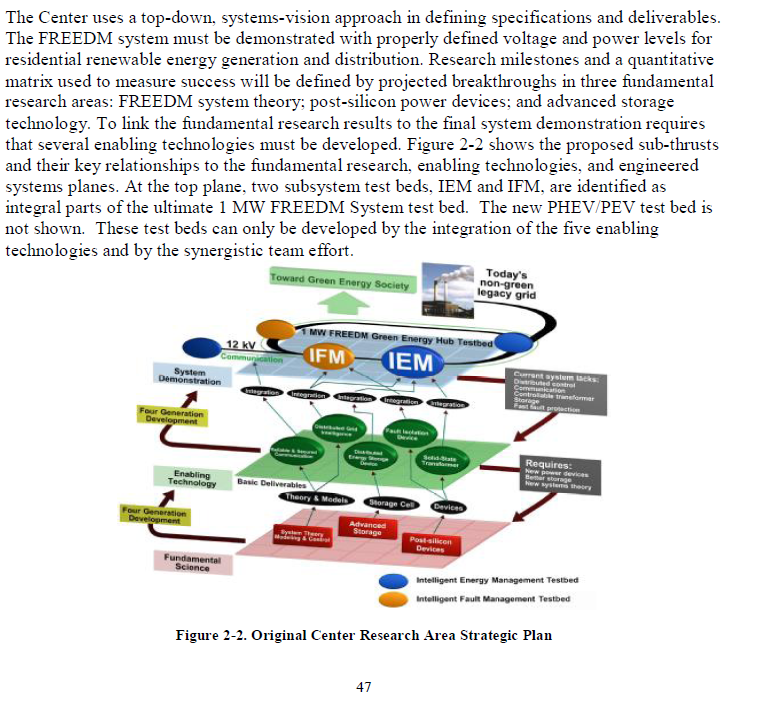
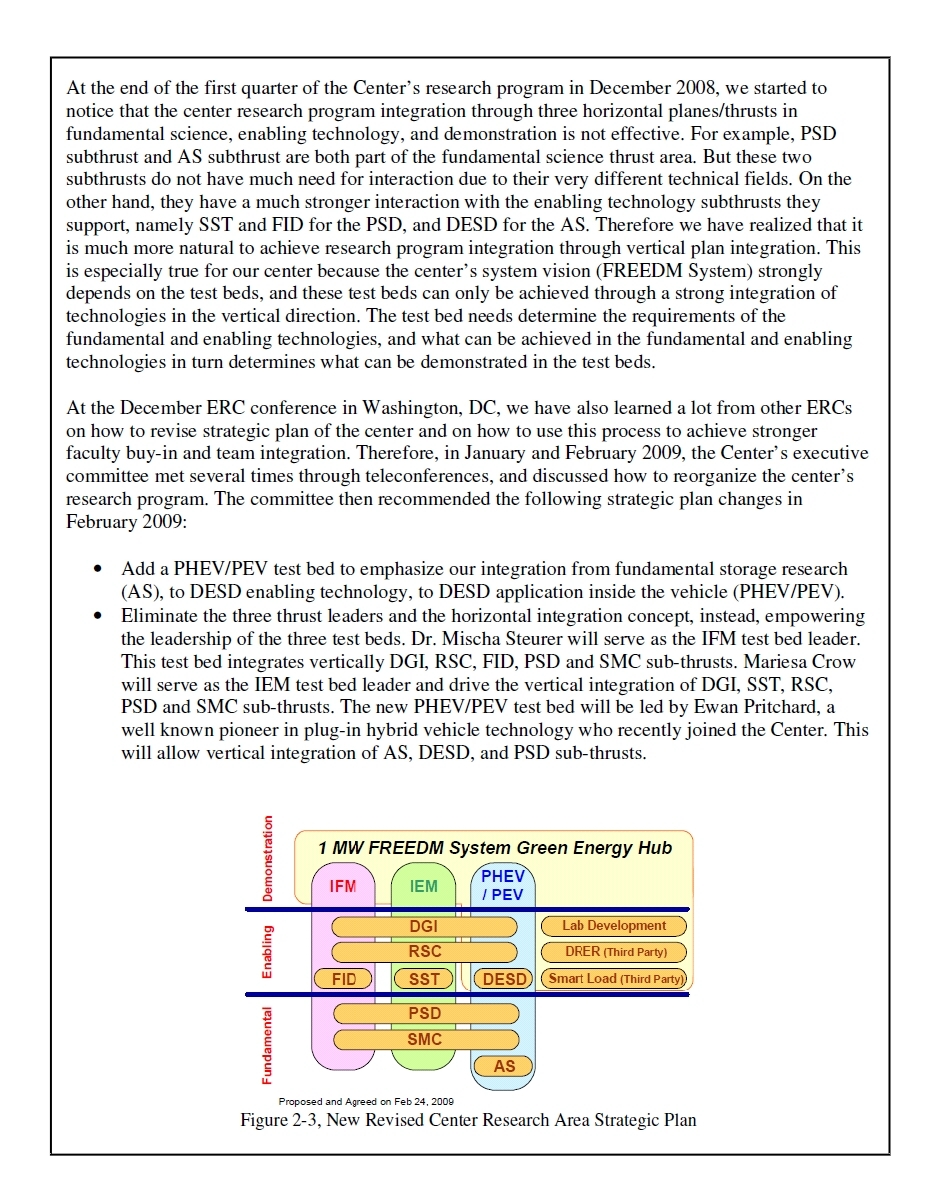
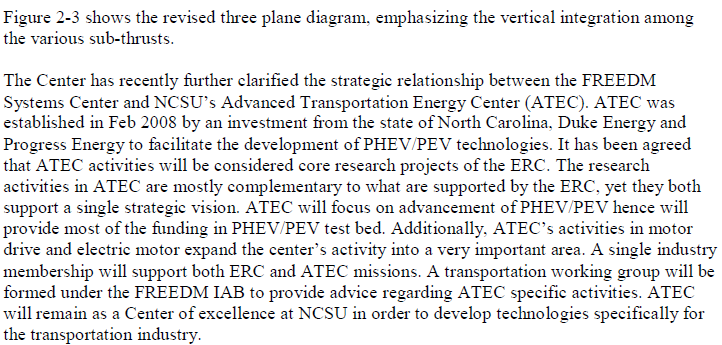
3.3.8.1 Changes to the Three-Plane Diagram
The example shown in Exhibit three.3.8.1 starts with the original relationship between the planes of the diagram; information technology then explains why that human relationship had to be inverse. The example also illustrates this ERC’southward approach, after discussions with other ERCs, to achieving stronger faculty purchase-in and team integration.
Showroom 3.3.8.1
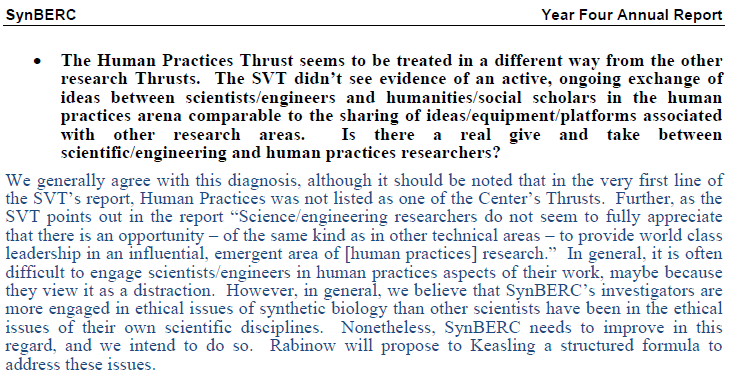
iii.3.8.ii Communication and Interrelationships
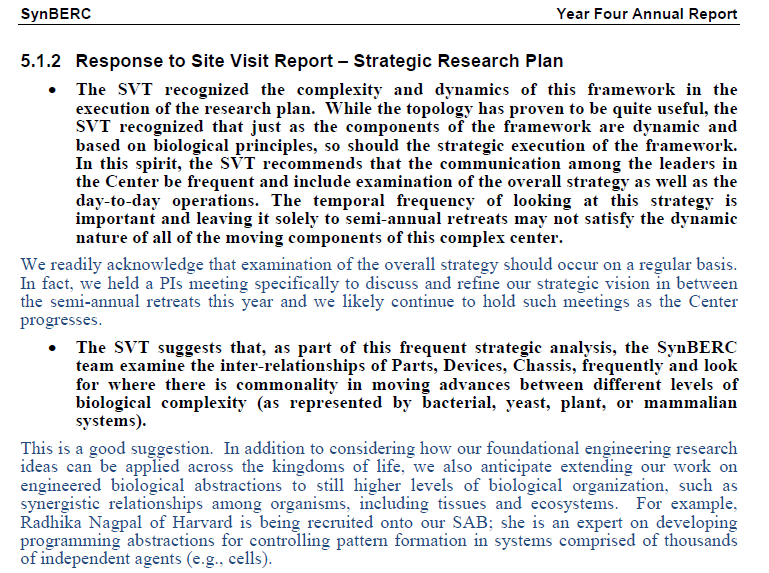
The post-obit example, responding to comments from a Site Visit Team (SVT) relates to best practices in the areas of communications and interactions that could identify commonalities.
Exhibit 3.3.8.2
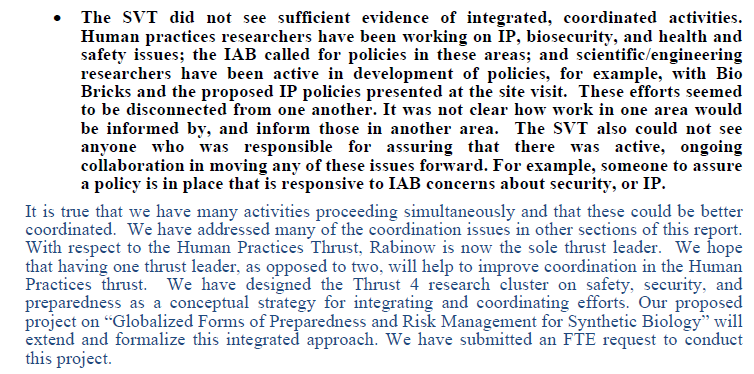
3.three.8.3 Keeping the Entire ERC Team Coordinated
Here the case (Exhibit 3.iii.8.three) illustrates the need to ensure that all elements of the team continue collaborating and working together in a coordinated way.
EXHIBIT iii.iii.8.3
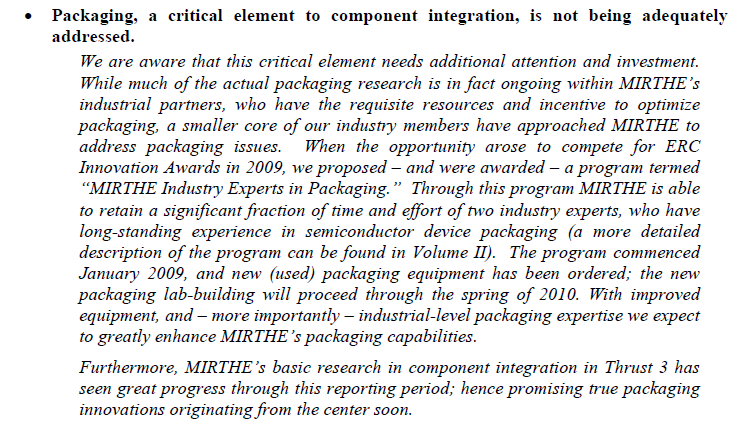
3.three.8.4 An Important Chemical element of Research Not Being Addressed Adequately
In this example (Exhibit 3.3.eight.4) it was learned that changes had to be made to include more attending and investment and so that i of import chemical element of enquiry (in this case, packaging) could be addressed adequately.
Showroom 3.three.eight.4
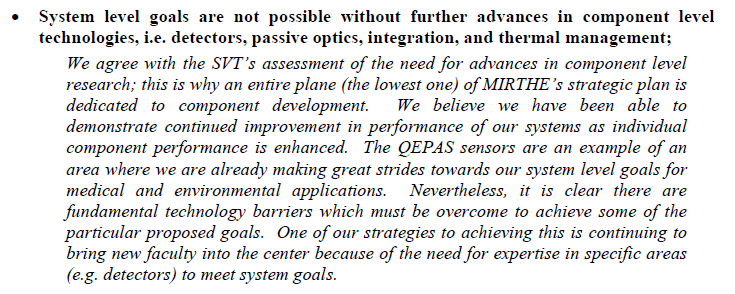
3.3.eight.5 Monitoring Progress and Deliverables
This last case (Exhibit iii.three.8.5) reveals that a site visit team discovered that achieving the center’s organization-level goals would not be possible without farther advances in component-level technologies. Ane element of the response was to proceed bringing new faculty into the centre to provide needed expertise. The earlier that monitoring of progress during implementation (a best practice) can identify shortfalls such as this, the earlier that corrective actions can be put into place.
Exhibit 3.3.8.5
Source: https://erc-assoc.org/book/export/html/724

Post a Comment for "What Amount of Manufacturing Overhead Costs Will Be Allocated to Jobã¢â‚¬â€¹ #316?"